Ditto
Firmware for the M-VAVE FM-1 · 1.0.1

Ditto

The FM-1 as a sampler of the mid-eighties, after the Emulator II and as dry as it was: a library of sixteen sounds, one or two on every note, through an 8-bit companded sample player into a 24 dB filter and a VCA, each with its ADSR, and one LFO. A grey panel, a two-line LCD, modules and their numbered functions.

Free · GPL-3.0 · by Gadlele · based on Felucca

Ditto's power-on animation on the FM-1's screen

What's new in 1.0.1

2026-10-24

  • HALL is mono: its stereo part made a loud hiss on the FM-1 while playing (not in the emulator). Now the hall is mono, as the Emulator II's outputs were; ROOM and SPRING are unchanged.
  • A user slot's sound no longer looks one slot past the last when a layer has no zone (no sound changes).

A panel from 1984

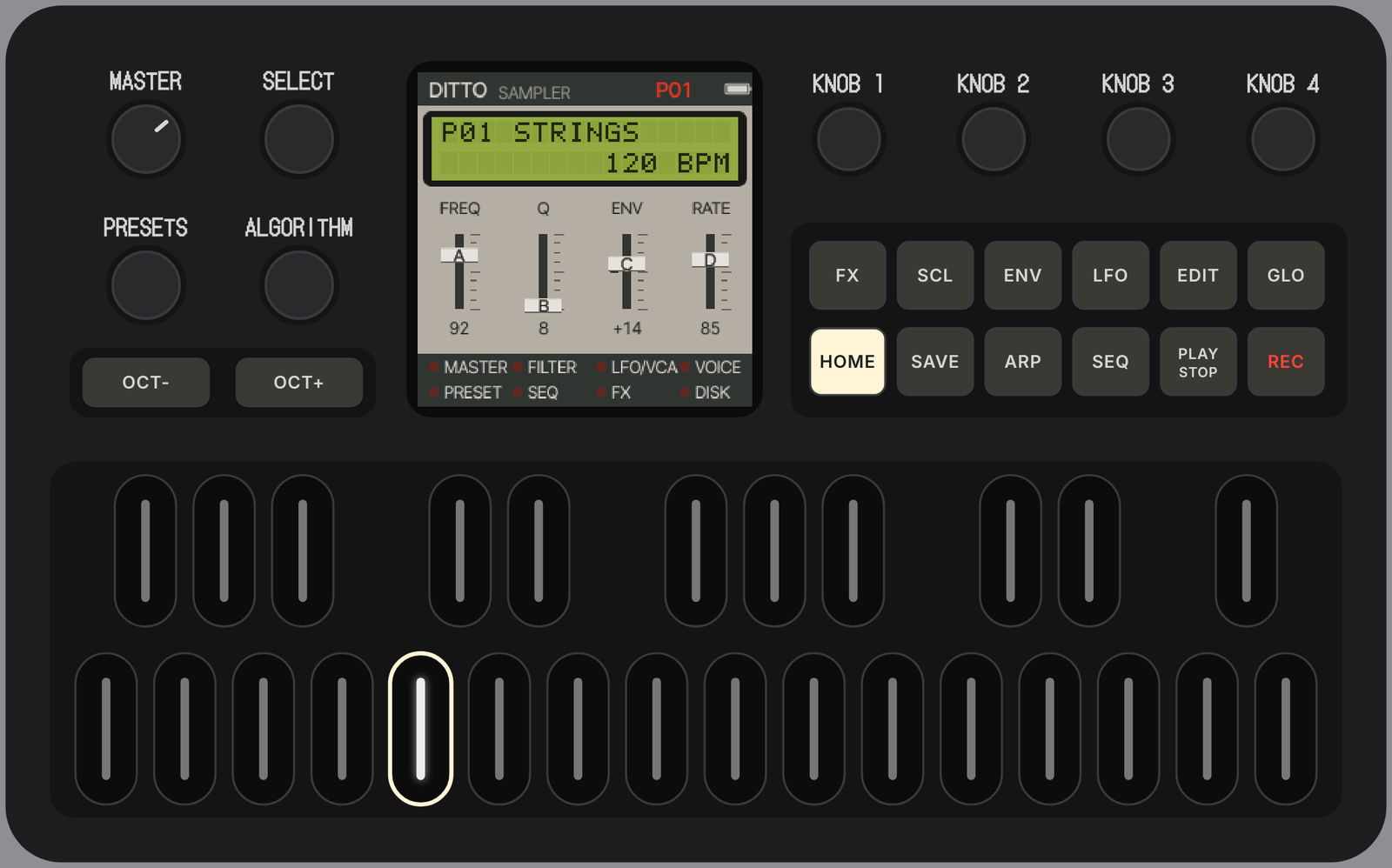
The buttons are the Emulator II's modules: GLO the MASTER, SCL the FILTER, ENV the LFO/VCA, EDIT the VOICE DEFINITION, SEQ the PRESET DEFINITION, REC the SEQUENCER, FX the effects, SAVE the DISK. Press a module again for its next function; KNOB 1–4 are the four sliders; the LCD says where you are.

The FM-1's panel running Ditto
Ditto running on a simulated FM-1, the same code the instrument runs. Play it.

What's inside

One sampler voice, the Emulator II's, with 32 presets.

A library of sixteen sounds

Strings, a choir, an orchestra hit, piano, brass, flute, cellos, organ, harpsichord, marimba, tubular bells, pizzicato, double bass, timpani, a breathy recorder, harp: 41 zones from CC0 recordings. Three slots for your own samples.

Two sounds a note

PRESET DEF assigns SOUND B, as the Emulator II's presets did: stacked, VELOCITY SWITCH, VELOCITY CROSSFADE, a SPLIT or a POSITIONAL CROSSFADE over a range of keys.

Eight bits

EII: 8-bit μ-law and no interpolation, the grain of the Emulator II. Or CLEAN, the recordings as they are.

The Emulator II's voice

A 24 dB low-pass with its ADSR, a VCA with its ADSR, one LFO with a delay to the pitch, the filter and the level; velocity to the level and the filter. No patch bay: the routings are the EII's.

START and LOOP

The notes start further into the sample, past its attack; a sustained sound loops while the key is held, or plays once through.

A grey panel

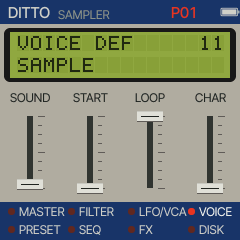
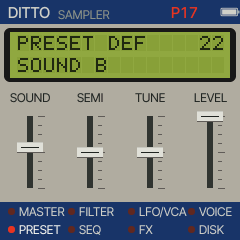
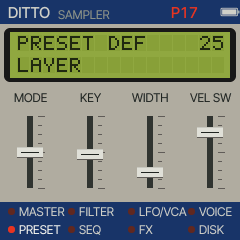
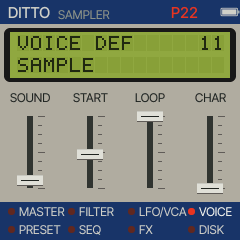
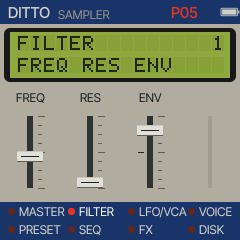
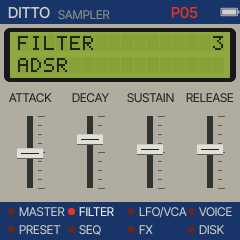
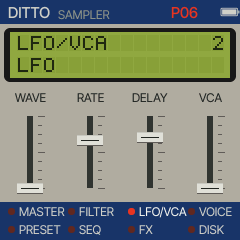
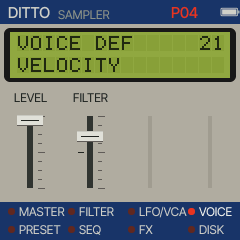
A two-line LCD in 5 × 7 dots, four sliders and the modules' LEDs: the functions numbered as on the instrument (FILTER 1, VOICE DEF 21, PRESET DEF 25).

Arpeggiator and sequencer

An arpeggiator in PRESET DEF, as on the EII; a small 16-step sequencer with ties, accents and slides, its steps drawn on the LCD.

Delay and reverb

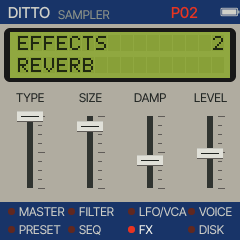
Only these two, as one would have patched them in 1984: a stereo delay in time with the tempo and a room, spring or hall reverb.

32 presets

24 factory sounds (STRINGS, CHOIR, ORCH HIT, PIANO, SHAKUHACHI, BOW + PLUCK, BASS / PIANO, BRASS / HIT, CELLO>CHOIR…) and eight free slots. MIDI Program Change picks them.

On the screen

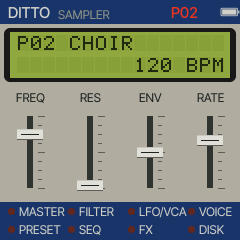
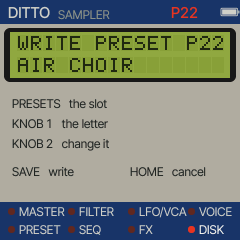
Real screens of Ditto 1.0, taken from the emulator.

Safe to try

Custom firmware should never be a one-way door.

Install from the browser

Chrome or Edge, a USB data cable, two minutes. The installer checks the package before writing and asks the FM-1 what it runs afterwards. An interrupted install resumes.

USB rescue

Hold OCT− while switching on (or let two starts fail) and the FM-1 starts a small rescue mode with only USB, ready for a new install. The boot code itself is never written.

Back to official

The installer can put M-VAVE's official V15 firmware back at any time, after saving your music to a file.

Ready?

Try it first in the browser, no FM-1 needed, or install it now.