COSMOS
Firmware for the M-VAVE FM-1 · in the making

COSMOS

A drone synthesizer played by the sky. The sun, the clouds, the air pressure, the geomagnetic activity and the moon shape a drone and the instrument above it, and the screen is the real sky above you.

Free · GPL-3.0 · by Gadlele

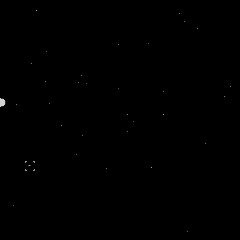
COSMOS's power-on: scattered stars gather into its name

Where it stands

2026-10-28

  • COSMOS 0.23, the radio in pairs: on the RADIO page (FX) the players now pair up at random, two by two: one plays the pad, the other the bells, each hearing the other as it plays, its keys lighting up. Listeners pick a pair in the constellation and hear both. Everyone hears it in the sounds of their own sky. While the radio is on, COSMOS's own sound rests; any other button leaves it. The test player can be your partner from a browser, and COSMOS in the browser plays on the radio too, as an FM-1. Install it.
  • COSMOS 0.22, players and listeners: FX opens the RADIO page. Be a player and your keys go out to whoever listens; be a listener and pick a player from a turning constellation, a star for each one where it is on the Earth, and hear it in your own sky's voice, half a second after it played, its keys lighting up yours. Violet for players, blue for listeners. No FM-1 to listen to? The test player plays on the radio from a browser. Install it.
  • COSMOS 0.21, RADIO COSMOS: press FX and your FM-1 tunes in: every FM-1 tuned in plays the same chords at the same moment, each under its own sky. Write the next chords together on the radio page (retired since), up to ten ahead, three notes each; an empty slot is the sky's. Also: the weather no longer fails with error 400, STARS PAD really plays each pad's voice, the page buttons work from every page (on the WiFi page SEQ looks again), and a lighter engine.
  • COSMOS 0.20, the stars of each pad: in the settings, STARS has a new choice, PAD: the stars play with the instrument's own voice. Grains for Quasar, whistles for Solar Wind, struck strings for Rings, bells played backwards for Horizon, bongos for Deep Field, bells of pulses for Supernova, and the rest.
  • COSMOS 0.19: PRESET is the drone's volume, in HOME and in EDIT (in EDIT the pressure's trend follows the way you turn K3).
  • COSMOS 0.18, the stellar engines: fifteen instruments, one for each weather by day and by night (Nebula, Aurora, Strings, Quasar, Organ, Voyager, Background, Horizon, Tape, Deep Field, Crystal, Rings, Solar Wind, Supernova, Gravity); eight voices for the stars, one for each phase of the moon; and when the Sun stirs, the stars turn into a sequence (Stargate) or the whole sky pulses (Pulsar). Each star plays where it is on the screen, left to right. The pressure colours the chords again.
  • COSMOS 0.17: the sound starts when the splash ends, fading in with the sky.
  • COSMOS 0.16: on the sky alone (LFO, ARP) the keys play without bringing the readings up.
  • COSMOS 0.15, the splash: at power-on the stars gather into the word COSMOS, hold, and fade into the sky; any button skips it. WiFi starts after it.
  • COSMOS 0.12: HOME after EDIT gives back the real sky at once, the weather and its instrument too.
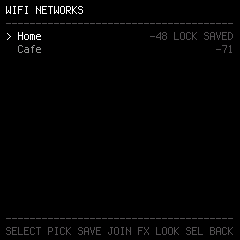
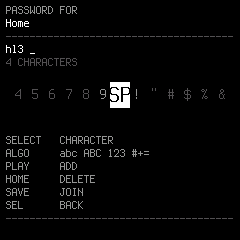
  • COSMOS 0.11, the real weather: COSMOS joins your WiFi and every half hour fetches the clouds, the pressure and its trend at your coordinates, and the Kp index; the time and your offset from UTC (summer time too) come with them. ENV opens the WiFi page: the networks around, the password on the knobs, WiFi off for offline. Up to six networks are remembered and joined by themselves.
  • COSMOS 0.10, the instruments: one soft drone underneath (FM, sliding to each chord in 1.5 s), and on top an instrument playing the whole chord, attacked anew at each change: ORGAN, STRINGS, CHOIR or WARM PAD. The pressure picks it (high the organ, low the choir), or the settings fix one. The planets give the scale and the chords.
  • COSMOS 0.9, the pads: the drones are now warm analog pads, each note two oscillators a few cents apart, with a slow PWM and a tape wow; each planet its own (SUN PAD, MOON, GLASS, WARM, TAPE, DRONE, HAZE), the moon's waves with none. The night is less muffled, so the chords are heard. The brightest stars stay on the screen even under clouds and by day, faint.
  • COSMOS 0.8, the arpeggiator: a line sweeps the sky and the stars it crosses play the scale by their height, the planets louder; ARP shows it, and what plays lights up. LFO shows the sky alone; the readings stay otherwise. The planets' bells are gone, the chords never stop going round, the buttons in use light up, and saving no longer breaks the sound while you play: COSMOS saves only when you stop it or leave the settings.
  • COSMOS 0.7, the buttons: HOME back to nature, EDIT the whole sky by hand on the knobs, SEL the planets, GLO the settings. The keyboard is one: a key plays the chord on its note (with a planet, the chord of its scale), and plays even with the sky stopped.
  • COSMOS 0.6, the harmony: the seven classical planets, each with its note (TUNING COSMIC, EQUAL or NATURAL) and four chords of its own, one every 10 seconds, in the mode the sun's height gives, coloured by the pressure.
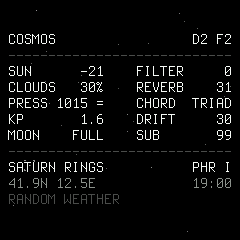
  • COSMOS 0.4, the sky: the sun, the moon, five planets and the 500 brightest stars computed on the FM-1; the screen is that sky, the readings fade in over it on a touch; the sun and the moon play the sound by themselves.
  • COSMOS 0.3, the engine: each drone a small instrument on its own note, a partner that beats against it, its own driven filter, breathing; a planet changes the engine and adds its voice; a tape-like delay, a long reverb, a battery gauge.
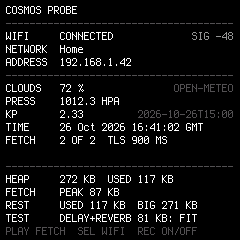
  • COSMOS PROBE 0.2, a test firmware (install it): it joins your WiFi, fetches the cloud cover and the pressure (Open-Meteo) and the Kp index (NOAA) over HTTPS, and shows how much memory WiFi leaves for COSMOS's delay and reverb. It makes no sound. First run on an FM-1: connected at −85 dBm, both sources in 386 ms, and room for a 1-second stereo delay beside the reverb. 0.2 keeps the password's big character in lower case when it is.
  • COSMOS in your browser: the real firmware running on a simulated FM-1, knobs, buttons, keys, screen and sound, with your computer's clock and a simulated weather. Try it.

Played by the sky

Every half hour the FM-1 asks the sky how it is, then lets the sound glide there. The slower a source changes, the deeper it reaches: the weather decides what instrument COSMOS is, the moon what the stars sing, a geomagnetic storm tears it apart now and then, the clouds and the sun colour it through the day.

Moon

29.5 days

The voice of the stars, a new one every few nights: drops at new moon, then kalimba, harp, celesta, wind chimes at full moon, glass, a music box, a flute. And the drone's light.

Weather

hours · drastic

The instrument, by day or by night: fifteen of them. A clear night is an aurora of octaves, rain at night strings ringing in sympathy, an overcast day a cathedral organ, a thunderstorm a black hole's pull. The pressure colours the chords.

Kp index

hours · storms are rare

The rhythm. A quiet sun gives a gentle drift. When it stirs, the stars become a Berlin-school sequence; in a geomagnetic storm the whole sky pulses like a pulsar.

Clouds

hours · medium

The space. A clear sky is dry and near; an overcast one washes the drones in reverb, delay and noise, and hides the stars.

Sun

every day · gentle

The light. Its height opens the filter from the dark of night to the brightness of noon, and follows the seasons by itself.

Planets

while they are in sight

The structure. A planet in the sky can be chosen: its note and its four chords. And the arpeggiator plays the stars and the planets as a line sweeps across them.

A window on the sky

White Terminus text on black, over the stars, the moon and the planets where they are above you now. Touch a control and the readings fade in; leave it and they fade back to the sky.

Playing COSMOS

On a computer with Chrome or Edge and the FM-1 on USB. Installing firmware is at your own risk; the installer puts M-VAVE's own firmware back too. Decline m-bootloader when it is offered: COSMOS does not need it.

  1. Install from the installer. The FM-1 restarts as COSMOS: the readings over the sky.
  2. Connect it: ENV opens the WiFi page. SELECT picks your network, SAVE joins it; for the password SELECT turns through the characters, ALGO jumps between abc ABC 123 #+=, PLAY adds, HOME deletes, SAVE joins. It is remembered (up to six networks) and joined by itself next time. REC turns WiFi off: offline, the weather drifts by itself. ENV goes back.
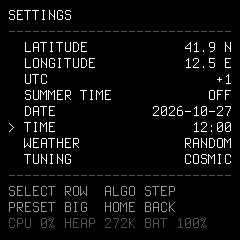
  3. Set your place (and, offline, the time): GLO opens the settings. SELECT picks a row (latitude, longitude, UTC offset, summer time, date, time, pad, stars (AUTO the moon's voice, one fixed, or PAD the pad's own), tuning), ALGO changes it a step, PRESET a big step, GLO saves and goes back.
  4. Nature or your hands: HOME gives everything back to nature: the sun and the moon as they are, the weather as it comes. EDIT puts the whole sky on the knobs: K1 the sun, K2 the clouds, K3 the pressure, K4 Kp, ALGO the moon. PRESET is the drone's volume, always.
  5. The planets: SEL goes round the seven in the sky (in EDIT all seven), the Sun and the Moon among them, and none. The one chosen gets four corners and plays its note and its four chords (one every 10 seconds). When it sets, it goes.
  6. The sky: LFO leaves the sky alone on the screen, and back. ARP shows the arpeggiator: a line sweeping the sky, the stars and planets it crosses playing and lighting up; ARP again turns it off. The buttons that do something glow, the keys glow on the scale.
  7. The radio: with WiFi on, FX opens the RADIO page and ALGO picks your role. Players pair up at random: one plays the pad (held while the key is), the other the bells, each hearing the other; alone, you play the bells until a partner comes. A listener sees the players on air as a constellation, a line joining each pair: SELECT goes from star to star, SAVE listens. Everything sounds in your own sky's pad and bells. While the radio is on, COSMOS's own sound rests and PLAY sleeps; any other button leaves it. To try it alone, open the test player: it pairs with your FM-1. No FM-1 at hand? COSMOS in the browser is on the radio too, with the FM-1s: its screen, its constellation, its keys lighting up when your partner plays.
  8. The keys: a key plays the chord on its note; with a planet, the chord of its scale for a while, then its four come back. PLAY stops the sky (and saves); stopped, the keys still play. OCT− OCT+ the octave, MASTER the volume.
  9. Back to stock: "Back to the stock firmware" on the installer page.